Intelligent Flask Applications
A curated collection of production-grade Flask architectures, AI agent workflows, real-time computer vision hubs, and asynchronous worker topologies.
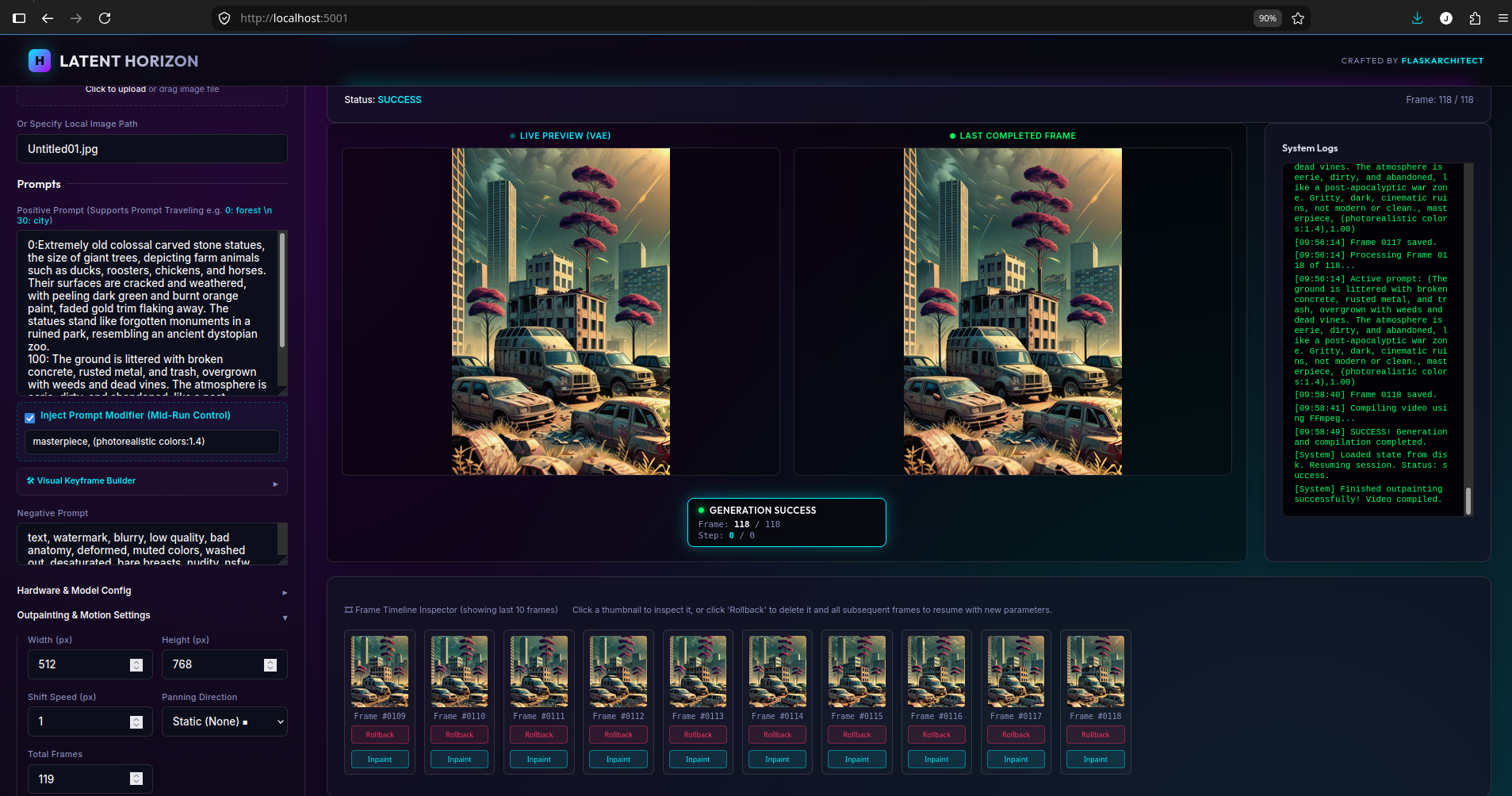
Latent-Horizon AI SLERP Video Creater
Blending & Interpolation in Stable Diffusion
Latent Space Prompt Blending & Interpolation in Stable Diffusion 🌀
In recursive image-to-image feedback loops (like Latent Infinite Zoom), transitioning smoothly between completely different visual concepts is a major challenge. If you simply change the prompt text abruptly between frames, the generation engine will undergo a jarring visual "cut," destroying the continuity of the zoom.
Instead of blending prompts as text strings, the engine in [LatentHorizon.py]
Latent-Horizon/LatentHorizon.py) performs Latent Space Prompt Blending—interpolating the raw numerical embedding vectors produced by the CLIP text encoder.
---
1. Theoretical Background: From Text to Latent Vectors
To understand latent space blending, we must look at how Stable Diffusion processes written language.
The Tokenizer and Text Encoder
1. Tokenization: Stable Diffusion cannot read letters. When you pass a prompt, a tokenizer breaks the text into word fragments ("tokens") and maps them to unique integers from its vocabulary.
2. Padding/Truncation: The pipeline standardizes prompt lengths to exactly 77 tokens (for Stable Diffusion 1.5). If a prompt is shorter, it is padded with empty/special tokens; if it is longer, it is truncated.
3. The CLIP Text Encoder: These 77 tokens are passed through a neural network (CLIP) that projects each token into a 768-dimensional space. The result is a prompt embedding tensor of shape
(1, 77, 768).
These embeddings represent the semantic concept of your prompt. Words like "ocean" and "water" will lie close to each other in this 768-dimensional coordinate system, while "fire" will lie far away.
---
2. Why Text Concatenation Fails
If you want an image that is $40\%$ "abandoned office" and $60\%$ "maintenance shop," a naive approach would be to concatenate the text strings:
"An abandoned office with trash and debris, a maintenance shop room filled with tools and cleaning supplies"...
[!NOTE]
LERP vs. SLERP: While VAE latent images (representing spatial pixel layouts) are often interpolated using Slerp (Spherical Linear Interpolation) to maintain vector magnitudes on a hypersphere, standard Lerp (Linear Interpolation) works exceptionally well for CLIP text embeddings because the attention mechanism relies on dot products, where directional magnitude scaling correlates closely with guidance influence.
- Zero-copy high performance pipeline
- Role-based access control
- Integrated OpenTelemetry distributed tracing
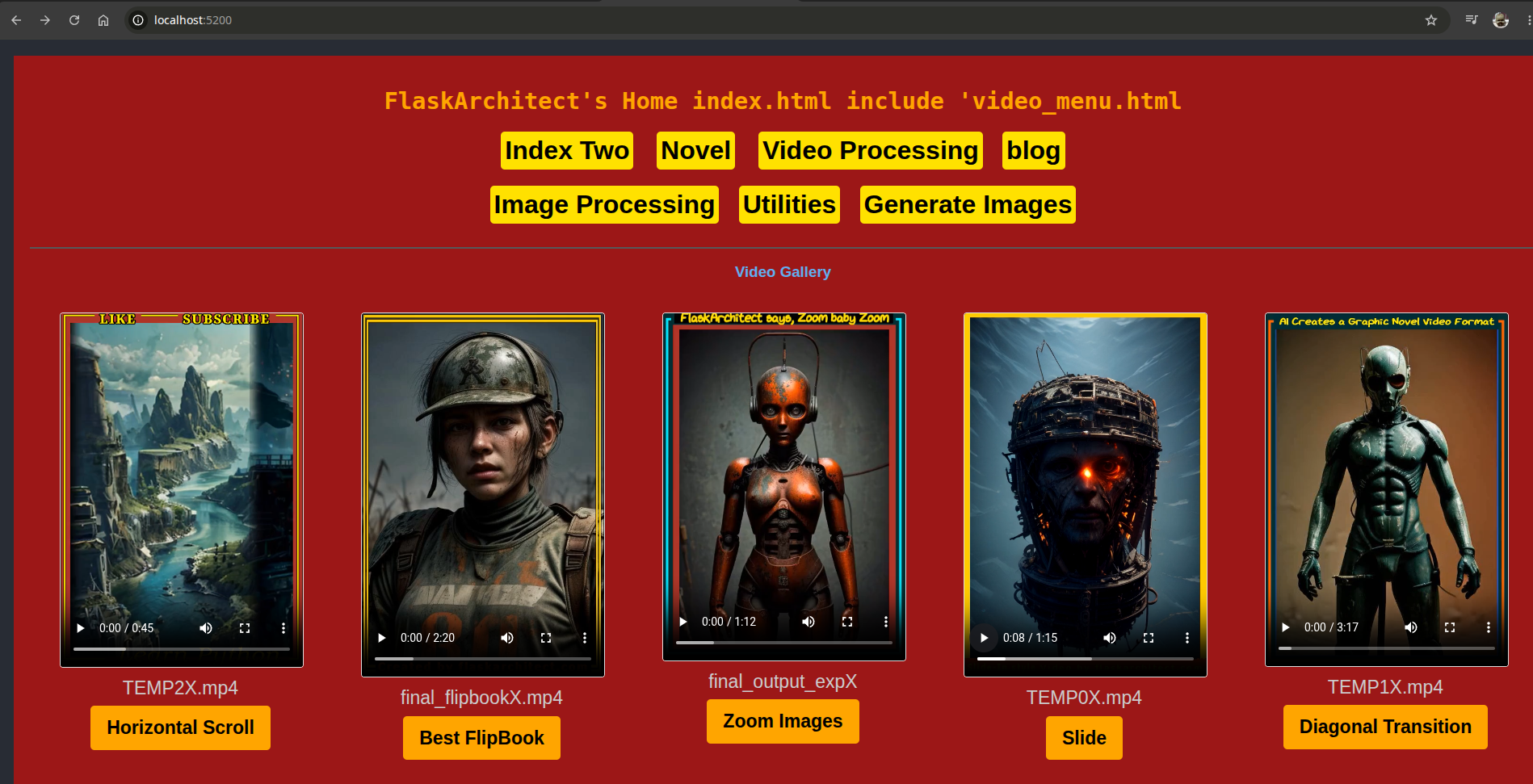
FlaskArchitect MediaStudio
Generative Image & Video Synthesis Web Studio
MediaStudio
Media Studio is a software designed for managing and organizing multimedia content. It provides an intuitive interface for users to upload, edit, and share their media files.
The module contains several classes and functions used for working with video and audio files, including file import and export, editing capabilities, and playback controls.
It also includes tools for metadata management, such as title, description, and tags. Additionally, the module supports various file formats, including MP4, MOV, AVI, and more.
Media Studio is ideal for content creators, videographers, and audio engineers who need a user-friendly and efficient platform for managing their media assets.
A creative asset synthesis workstation built with Flask, Diffusers, and WebAssembly image processors. Provides an intuitive studio interface for generating 4K visual assets, procedural textures, and video interpolations.
- Interactive prompt matrix generator with weight modifiers
- Integrated background removal and upscale shaders
- Direct S3 presigned upload & streaming CDN delivery
- Preset library for skeuomorphic UI textures and neural art